Why Offline-First Apps Are the Future of Mobile Finance Management
Discover how offline-first architecture is revolutionizing personal finance apps by prioritizing privacy, security, and user experience.
The Privacy Crisis in Financial Apps
In today's digital age, financial apps have become indispensable tools for managing personal finances. However, the convenience of cloud-based solutions comes at a significant cost: your privacy. Every transaction you log, every expense you track, and every financial goal you set is uploaded to remote servers, creating a detailed profile of your financial life.
Recent data breaches affecting millions of users have highlighted the vulnerabilities of cloud-first applications. When your financial data resides on someone else's servers, you're placing immense trust in their security measures, privacy policies, and business practices.
This is where offline-first apps are changing the game entirely.
What is Offline-First Architecture?
Offline-first is a mobile app development philosophy that prioritizes local data storage and functionality without requiring an internet connection. Unlike traditional cloud-based apps that sync everything to remote servers, offline-first apps store your data directly on your device.
Key Principles of Offline-First Design:
- ✓ Local-First Data Storage: All data is stored on the user's device
- ✓ Full Functionality Without Internet: Core features work completely offline
- ✓ User-Controlled Sync: Users decide when and what to sync
- ✓ Privacy by Design: No mandatory cloud storage or accounts
- ✓ Enhanced Security: Reduced attack surface with local encryption
This approach transforms the relationship between users and their data, placing control firmly in the hands of the individual.
Why Offline-First Matters for Finance Apps
1. Uncompromised Privacy
Your financial data is among the most sensitive information you own. With offline-first apps, your expenses, income, and financial patterns never leave your device unless you explicitly choose to export them. There are no servers to hack, no databases to breach, and no third parties analyzing your spending habits.
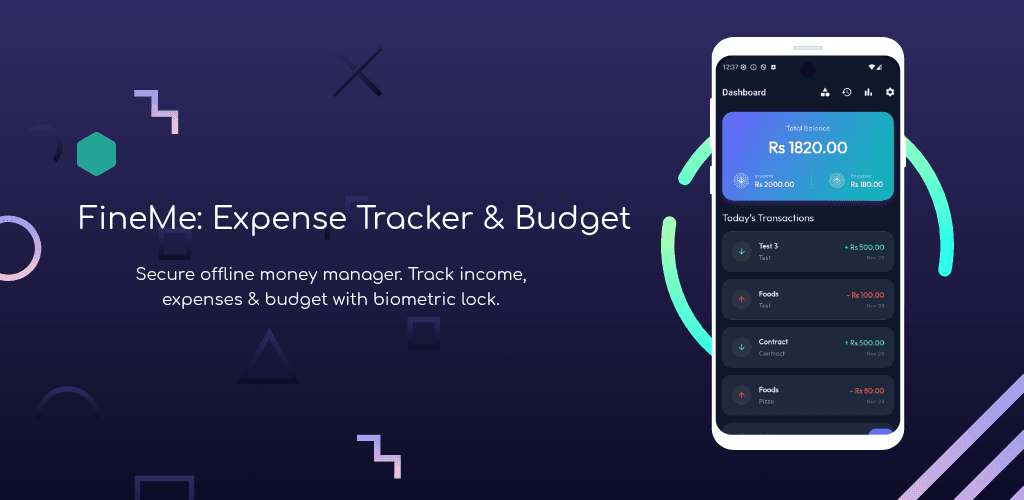
Apps like FineMe exemplify this approach by storing all financial data locally with military-grade encryption, ensuring that your financial life remains truly private.
2. Enhanced Security
Offline-first architecture dramatically reduces the attack surface. Without cloud servers storing millions of user records, hackers have no central target to compromise. Even if someone gains physical access to your device, biometric authentication and encryption provide additional layers of protection.
3. Always Available, Anywhere
Whether you're in a remote location, traveling internationally, or experiencing network issues, offline-first apps continue functioning flawlessly. You can track expenses on a flight, review budgets in areas with poor connectivity, or manage finances during internet outages without any interruption.
4. Improved Performance
Without constant server communication, offline-first apps deliver instant responses. No loading spinners waiting for API calls, no lag when viewing reports, and no delays when adding transactions. Everything happens immediately because it's happening locally.
5. True Data Ownership
You own your data completely. You can export it anytime, back it up to your preferred location, and never worry about a service shutting down and taking your financial history with it.
The Technology Behind Offline-First Finance Apps
Building robust offline-first applications requires sophisticated technology and careful architecture. Here are the key components:
Local Database Systems
Modern mobile databases like SQLite, Realm, or SQLCipher provide powerful local storage with encryption capabilities. These systems can handle complex queries, relationships, and large datasets entirely on-device.
Client-Side Encryption
All sensitive data is encrypted before being written to storage. Advanced apps use AES-256 encryption, ensuring that even with device access, data remains protected without the correct authentication.
Biometric Authentication
Integration with device biometric systems (fingerprint, Face ID) provides secure, convenient access while maintaining the offline-first principle.
Balancing Offline-First with Smart Features
One concern about offline-first apps is whether they can offer advanced features like AI-powered insights. The answer is yes, through hybrid approaches:
- •Optional Cloud AI: Apps can offer optional AI features that process data in the cloud with user consent, while keeping core functionality offline.
- •On-Device AI: Modern smartphones have powerful processors capable of running machine learning models locally for receipt scanning and pattern recognition.
- •Privacy-Preserving Analytics: Anonymized, aggregated data can be processed for insights without compromising individual privacy.
This balanced approach, used by apps like FineMe, demonstrates that users don't have to choose between privacy and innovation.
Real-World Benefits: User Perspectives
Users of offline-first finance apps consistently report several advantages:
Peace of Mind
No anxiety about data breaches or unauthorized access to financial information stored in the cloud.
Instant Responsiveness
Lightning-fast performance without network latency or loading delays.
Work Anywhere
Full functionality in any location, regardless of network availability.
Data Control
Complete ownership and control over financial records and backups.
The Future of Financial Apps is Offline-First
As privacy concerns grow and users become more aware of data collection practices, offline-first architecture represents the future of personal finance management. The trend is clear: users want powerful features without sacrificing privacy.
Major technology companies are recognizing this shift, with Apple and Google both emphasizing privacy and on-device processing in their platforms. The tools and frameworks for building sophisticated offline-first apps continue to improve, making this approach more accessible to developers.
Apps like FineMe are pioneering this movement in the finance space, proving that users don't need to compromise between convenience and privacy. As more users experience the benefits of offline-first apps, we expect this architecture to become the standard rather than the exception.
Conclusion: Taking Control of Your Financial Data
The offline-first approach to mobile finance apps represents a fundamental shift in how we think about personal data. By keeping your financial information on your device, encrypted and under your control, these apps offer a level of privacy and security that cloud-first solutions simply cannot match.
Whether you're concerned about privacy, need reliable offline access, or simply want faster performance, offline-first finance apps deliver on all fronts. They prove that modern technology can serve users without exploiting their data.
As we move forward in an increasingly connected world, the paradox is clear: the most secure and private financial apps are those that work best when disconnected.
Experience Offline-First Finance Management
Discover FineMe, the AI-powered finance app that puts privacy first
Learn More About FineMe